*zenbones.txt* For NVIM v0.4.3 Last change: 2021 September 05
==============================================================================
Table of Contents *zenbones-table-of-contents*
1. Zenbones |zenbones-zenbones|
- Requirements |zenbones-requirements|
- Installation |zenbones-installation|
- Usage |zenbones-usage|
- Configuration |zenbones-configuration|
- Other plugins support |zenbones-other-plugins-support|
- Advanced Usage |zenbones-advanced-usage|
- Other implementations |zenbones-other-implementations|
- Inspirations |zenbones-inspirations|
==============================================================================
1. Zenbones *zenbones-zenbones*
Zenbones is a light vim/neovim |colorscheme| designed to highlight code using
contrasts and font variations. Colors are tasked only for other roles such as
diagnostics, diffs, search matches.
REQUIREMENTS *zenbones-requirements*
Primarily built for neovim but it works pretty well with vim. However here are
some requirements to take full advantage of the colorscheme:
- 24-bit RGB colors (neovim or vim compiled with +termguicolors)
- Font with bold and italic
- Terminal or GUI with bold and italic support
INSTALLATION *zenbones-installation*
Example installation using packer:
>
use "mcchrish/zenbones.nvim"
-- Optionally install Lush. Useful if you want to extend the theme
-- e.g. create a statusline plugin theme using zenbones colors
use "rktjmp/lush.nvim"
-- See Advanced Usage section for more details
<
USAGE *zenbones-usage*
Just apply the colorscheme as usual:
>
set termguicolors
colorscheme zenbones
<
Alternatively, if you want to make use of the lua version:
>
set termguicolors
colorscheme zenbones-lush
<
It works pretty much the same as the first one but pretty handy when extending
or customizing the colors to your likings.
CONFIGURATION *zenbones-configuration*
Configuration is only available for `zenbones-lush`.
*zenbones-g:zenbones_lightness*
g:zenbones_lightness Change background colors lightness.
**'bright'**
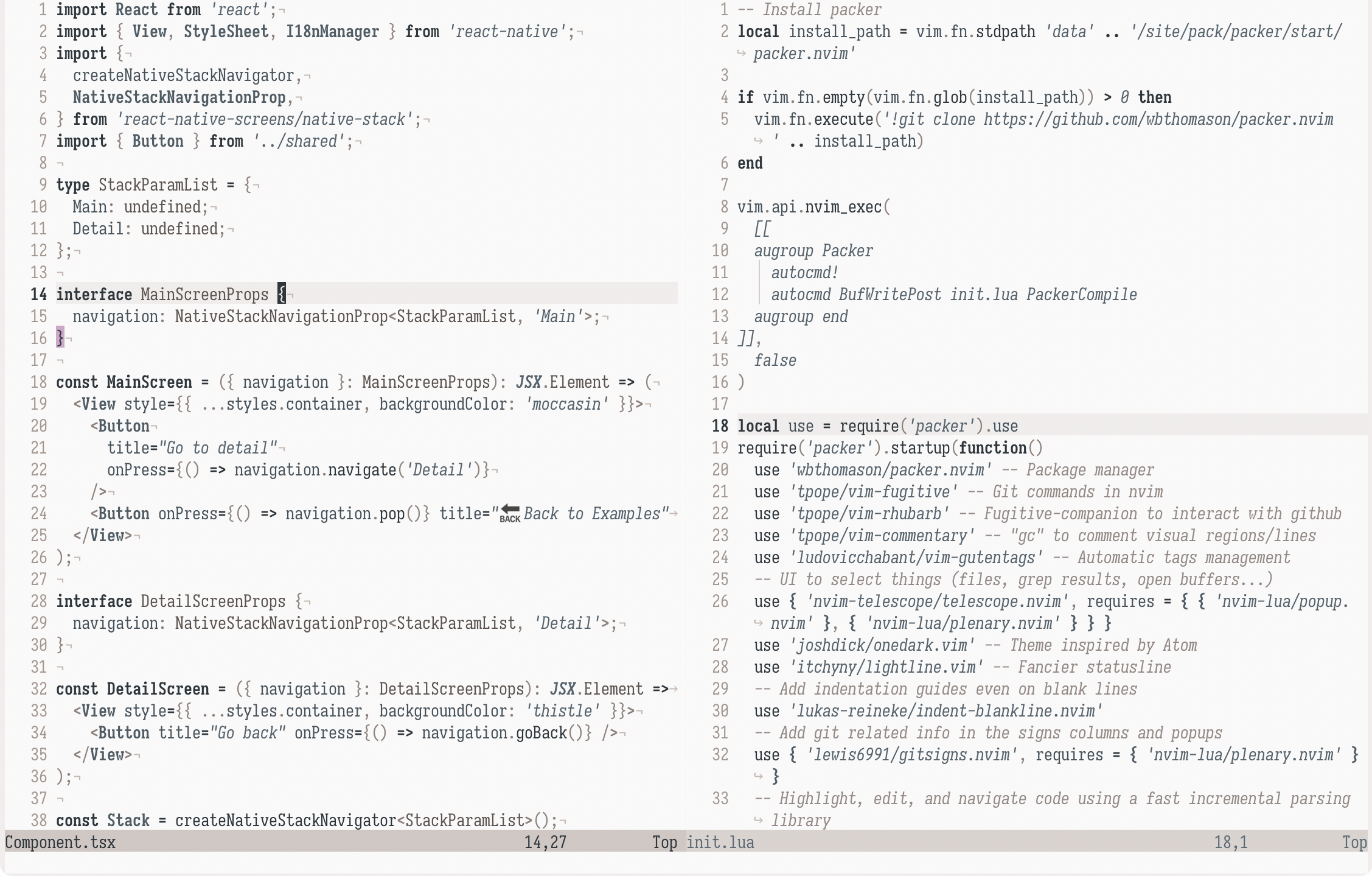 **Default** _(unset)_
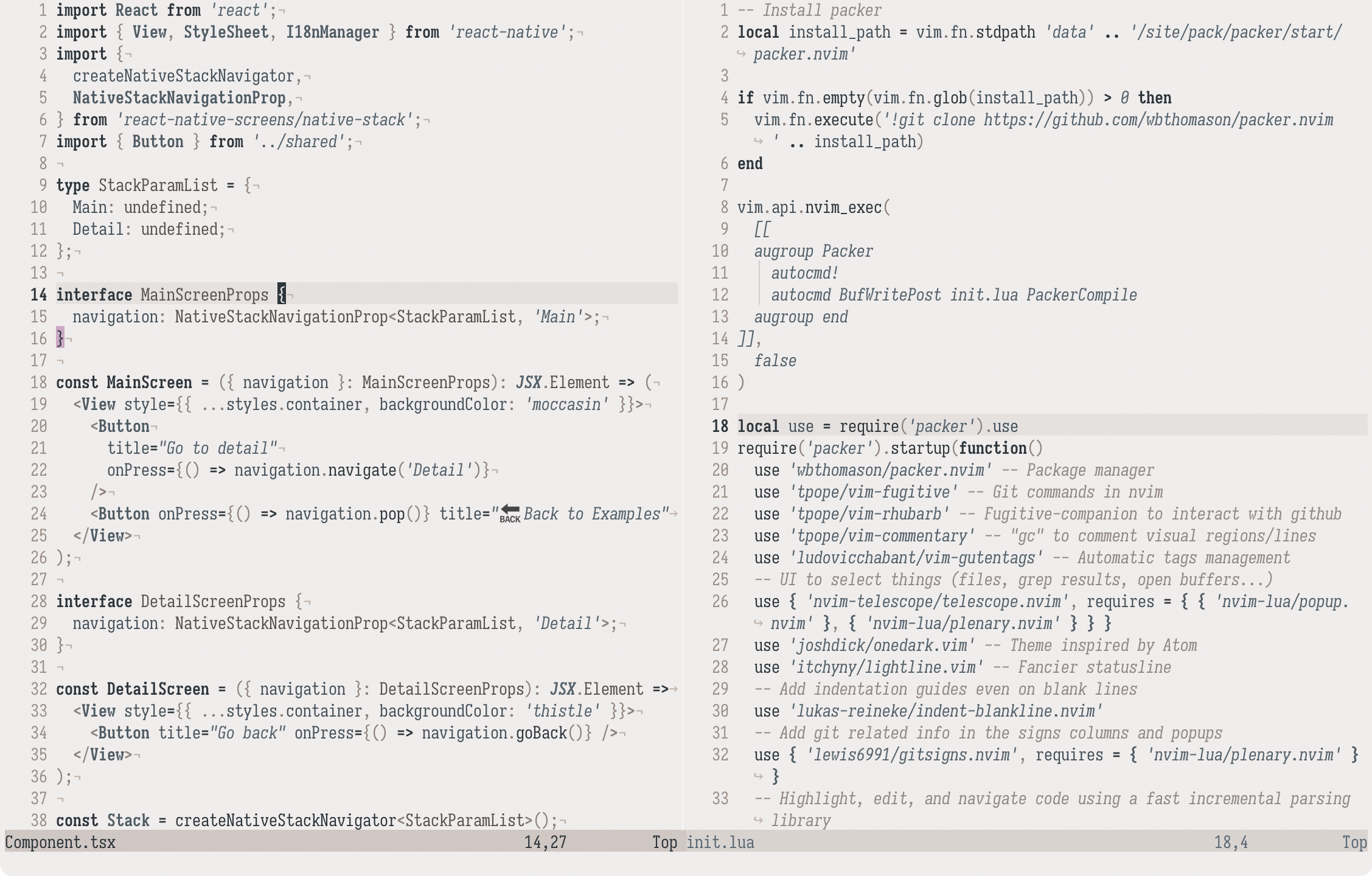 **'dim'**
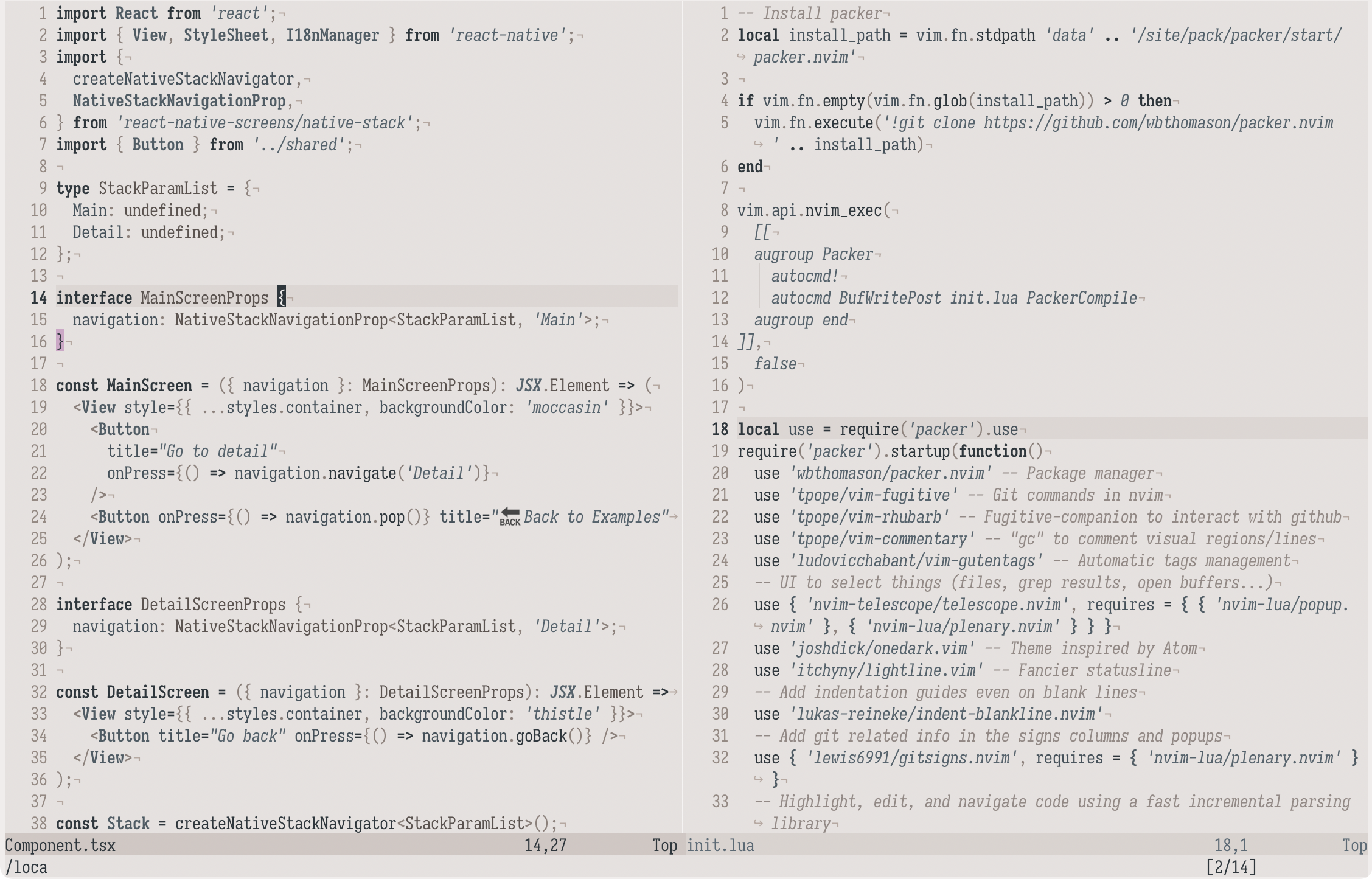 *zenbones-g:zenbones_solid_vert_split*
g:zenbones_solid_vert_split Set to `v:true` to make vertical split
more visible with a dimmer background
highlight.
*zenbones-g:zenbones_dim_noncurrent_window*
g:zenbones_dim_noncurrent_window Set to `v:true` to make non-current
window background dimmer than _Normal_.
OTHER PLUGINS SUPPORT *zenbones-other-plugins-support*
Aside from LSP and basic Tree-sitter support, here are some plugins that are
currently supported.
- Git Signs
- Git Gutter
- Indent Blankline
- Telescope
- Sneak
- Lualine
- BarBar
- CoC
- Neogit
ADVANCED USAGE *zenbones-advanced-usage*
Zenbones is pretty extensible thanks to Lush
. You can easily retrieve the colors in
lua:
>
local theme = require "zenbones"
local colors = require "zenbones.colors"
print(theme.StatusLine.bg.hex)
print(sand.darken(20).hex)
<
See also Lush’s documentation
for the complete options.
OTHER IMPLEMENTATIONS *zenbones-other-implementations*
- iTerm2
- Kitty
- Alacritty
- WezTerm
PRINT TERMINAL COLORS
You can retrieve the terminal colors by using this command:
>
:lua require("zenbones.print").print_terminal_colors()
<
Useful when you want to apply a zenbones theme to your terminal. Recent output:
>
Terminal colors
foreground: #2C363C
background: #F0EDEC
ansi color0: #2C363C
ansi color1: #A8334C
ansi color2: #617437
ansi color3: #944927
ansi color4: #286486
ansi color5: #88507D
ansi color6: #3B8992
ansi color7: #F0EDEC
ansi color8: #44525B
ansi color9: #9C2842
ansi color10: #55672A
ansi color11: #87411E
ansi color12: #1F5A7A
ansi color13: #864079
ansi color14: #2F7C85
ansi color15: #DCD2CE
cursor foreground: #F2F0EF
cursor background: #2C363C
inactive cursor foreground: #F2F0EF
inactive cursor background: #4D5C65
selection background: #D2DFE7
<
It’s also possible to generate color configuration files using a template,
this one for Kitty for example. Please feel free
to submit a PR if you want to add some more.
INSPIRATIONS *zenbones-inspirations*
Zenbones is heavily inspired by Verdandi
and vim-yin-yang
. The name came from a book called
Zen Flesh, Zen Bones .
There are more similar colorschemes with few colors from this collection
.
Generated by panvimdoc
vim:tw=78:ts=8:noet:ft=help:norl:
*zenbones-g:zenbones_solid_vert_split*
g:zenbones_solid_vert_split Set to `v:true` to make vertical split
more visible with a dimmer background
highlight.
*zenbones-g:zenbones_dim_noncurrent_window*
g:zenbones_dim_noncurrent_window Set to `v:true` to make non-current
window background dimmer than _Normal_.
OTHER PLUGINS SUPPORT *zenbones-other-plugins-support*
Aside from LSP and basic Tree-sitter support, here are some plugins that are
currently supported.
- Git Signs
- Git Gutter
- Indent Blankline
- Telescope
- Sneak
- Lualine
- BarBar
- CoC
- Neogit
ADVANCED USAGE *zenbones-advanced-usage*
Zenbones is pretty extensible thanks to Lush
. You can easily retrieve the colors in
lua:
>
local theme = require "zenbones"
local colors = require "zenbones.colors"
print(theme.StatusLine.bg.hex)
print(sand.darken(20).hex)
<
See also Lush’s documentation
for the complete options.
OTHER IMPLEMENTATIONS *zenbones-other-implementations*
- iTerm2
- Kitty
- Alacritty
- WezTerm
PRINT TERMINAL COLORS
You can retrieve the terminal colors by using this command:
>
:lua require("zenbones.print").print_terminal_colors()
<
Useful when you want to apply a zenbones theme to your terminal. Recent output:
>
Terminal colors
foreground: #2C363C
background: #F0EDEC
ansi color0: #2C363C
ansi color1: #A8334C
ansi color2: #617437
ansi color3: #944927
ansi color4: #286486
ansi color5: #88507D
ansi color6: #3B8992
ansi color7: #F0EDEC
ansi color8: #44525B
ansi color9: #9C2842
ansi color10: #55672A
ansi color11: #87411E
ansi color12: #1F5A7A
ansi color13: #864079
ansi color14: #2F7C85
ansi color15: #DCD2CE
cursor foreground: #F2F0EF
cursor background: #2C363C
inactive cursor foreground: #F2F0EF
inactive cursor background: #4D5C65
selection background: #D2DFE7
<
It’s also possible to generate color configuration files using a template,
this one for Kitty for example. Please feel free
to submit a PR if you want to add some more.
INSPIRATIONS *zenbones-inspirations*
Zenbones is heavily inspired by Verdandi
and vim-yin-yang
. The name came from a book called
Zen Flesh, Zen Bones .
There are more similar colorschemes with few colors from this collection
.
Generated by panvimdoc
vim:tw=78:ts=8:noet:ft=help:norl: